
How Watch Valuations Work: Wholesale Data, Condition & Mechanics
An insider's breakdown of institutional horological appraisal: live wholesale indices, Witschi acoustic amplitude testing, case bevel integrity, and stolen registry screening.
Executive Summary & Key Takeaways
- Collateral loan valuations rely on active secondary wholesale market clearing prices—what professional dealers pay in cash today—rather than retail MSRP or insurance appraisal figures.
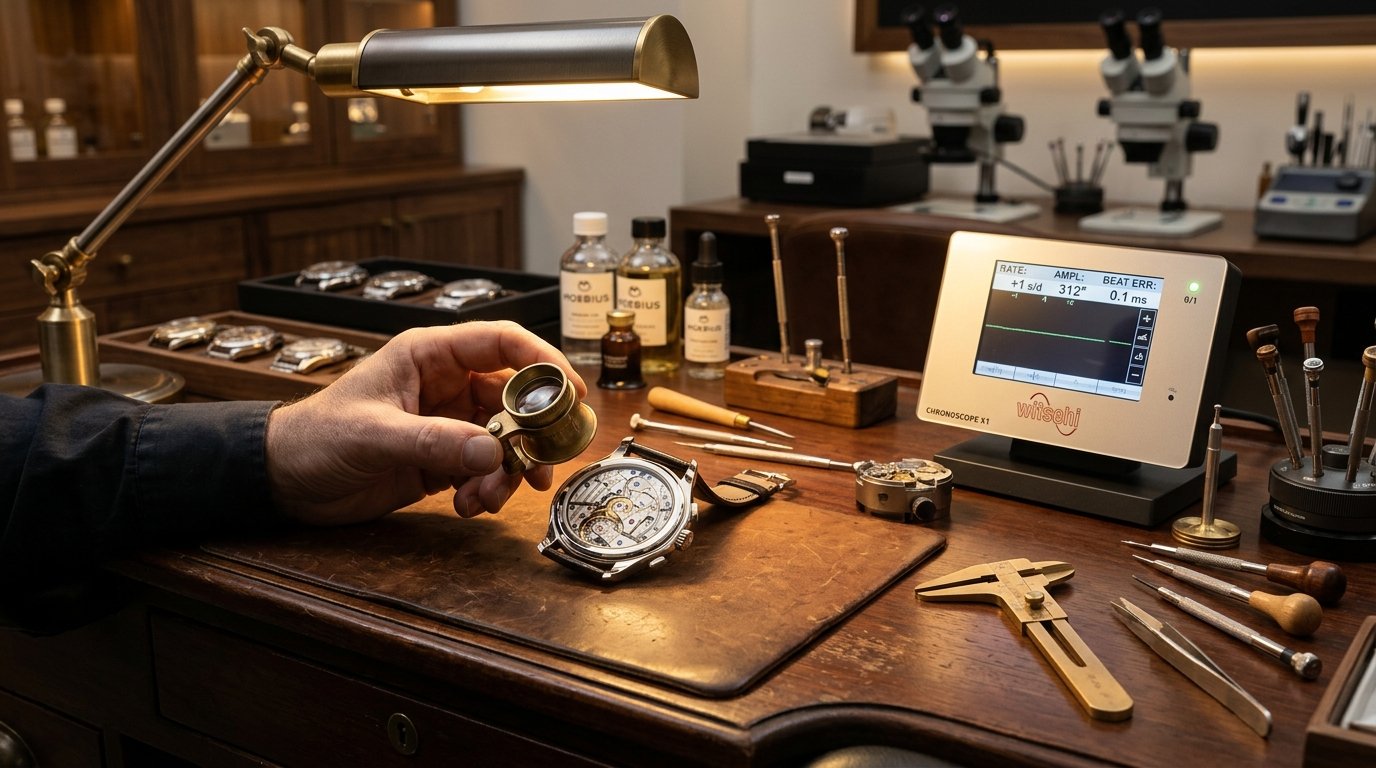
- Non-invasive electronic testing on Witschi timegraphers measures balance amplitude (target 270°–310°), rate deviation, and beat error without unsealing the case.
- Unpolished factory lug bevels and minimal bracelet pin stretch preserve top-tier wholesale grading, while aggressive aftermarket polishing creates value deductions.
- Every timepiece serial number is cross-referenced with The Watch Register and Art Loss Register prior to disbursement to certify clean legal title.
1. Wholesale Market Clearing Prices vs. Insurance Appraisals
The single most common source of confusion among borrowers is the vast discrepancy between insurance replacement appraisals and collateral lending valuations.
Insurance replacement documents represent retail replacement cost—the highest theoretical retail price an authorized dealer or boutique might charge to replace a watch at retail, often including sales tax, brand markup, and boutique overhead. These documents are designed to establish maximum claims payouts, not liquid cash values.
In contrast, collateral lenders operate in the secondary wholesale liquidity market. The valuation benchmark is the immediate dealer clearing price: the exact amount that institutional watch trading desks and verified dealers wire daily to acquire that specific reference in immediate cash.
The Insurance Appraisal Trap
An insurance appraisal stating a Rolex Datejust is valued at $14,000 does not mean a lender will advance 80% of $14,000. If that reference trades on the wholesale dealer exchange at $8,500, the 80% LTV is calculated against the $8,500 baseline.
2. Non-Destructive Mechanical Diagnostics (Witschi Testing)
A luxury mechanical watch is a micro-mechanical engine vibrating at 28,800 beats per hour (4Hz). Its internal mechanical health dictates whether it can clear the market immediately or requires a multi-thousand-dollar overhaul from the manufacture.
Rather than taking movements apart, certified horological underwriters employ Swiss-manufactured Witschi acoustic electronic timegraphers. By capturing the acoustic pulse of the balance wheel escapement across multiple positional orientations (dial up, dial down, crown down), underwriters evaluate three critical diagnostic metrics:
A. Balance Amplitude (Healthy: 270° – 315°)
Amplitude measures the degrees of rotation the balance wheel oscillates during each vibration. An amplitude below 230° indicates dried synthetic lubricants, worn jewels, or mainspring fatigue, necessitating service.
Healthy amplitude above 270° confirms robust gear-train power transfer, eliminating the need for mechanical reserve deductions in the loan advance.
B. Daily Rate Deviation (+/- 2 to 5 Seconds/Day)
Measures daily timekeeping accuracy against COSC and METAS chronometric tolerances. Consistent rate deviation across all five testing positions confirms escapement stability.
C. Beat Error (Healthy: < 0.3 ms)
Beat error measures the symmetrical alignment of the impulse jewel within the pallet fork. A beat error below 0.3 milliseconds verifies that the movement is operating with minimal frictional loss.
3. Case Bevels, Dial Integrity & Bracelet Stretch
In high-end horology, originality reigns supreme. Modern collector markets heavily penalize over-polished cases where razor-sharp factory chamfers have been rounded off on buffing wheels.
Underwriters inspect four primary physical parameters under 20x stereo magnification:
Case Geometry & Lug Chamfers
Original satin brushing contrasting with mirror-polished bevels (especially on Royal Oak and Nautilus cases) confirms that factory dimensions remain intact.
Dial & Bezel Preservation
Microscopic dial printing, applied markers, and ceramic/aluminum bezel inserts are checked for cracks, fading, moisture discoloration, and aftermarket alterations.
Bracelet Pin Stretch
Solid gold and steel bracelets (e.g., Rolex Jubilee or President) are suspended horizontally to evaluate gravitational droop caused by internal pin wear. Minimal stretch commands the highest market grading tier.
4. Completeness & Serial Provenance Screening
While a naked watch can be authenticated directly, having the original presentation box, instruction manuals, green/red hangtags, and particularly the original authorized dealer guarantee card significantly influences wholesale marketability.
A full 'collector set' reassures wholesale buyers of provenance and typically commands a 5% to 15% valuation premium over naked timepieces.
Finally, every serial number engraved on the rehaut, case flank, or movement bridge is cross-referenced through international stolen luxury property registers—including The Watch Register and Art Loss Register—to confirm unencumbered, clean legal title.
Related Guides & Articles
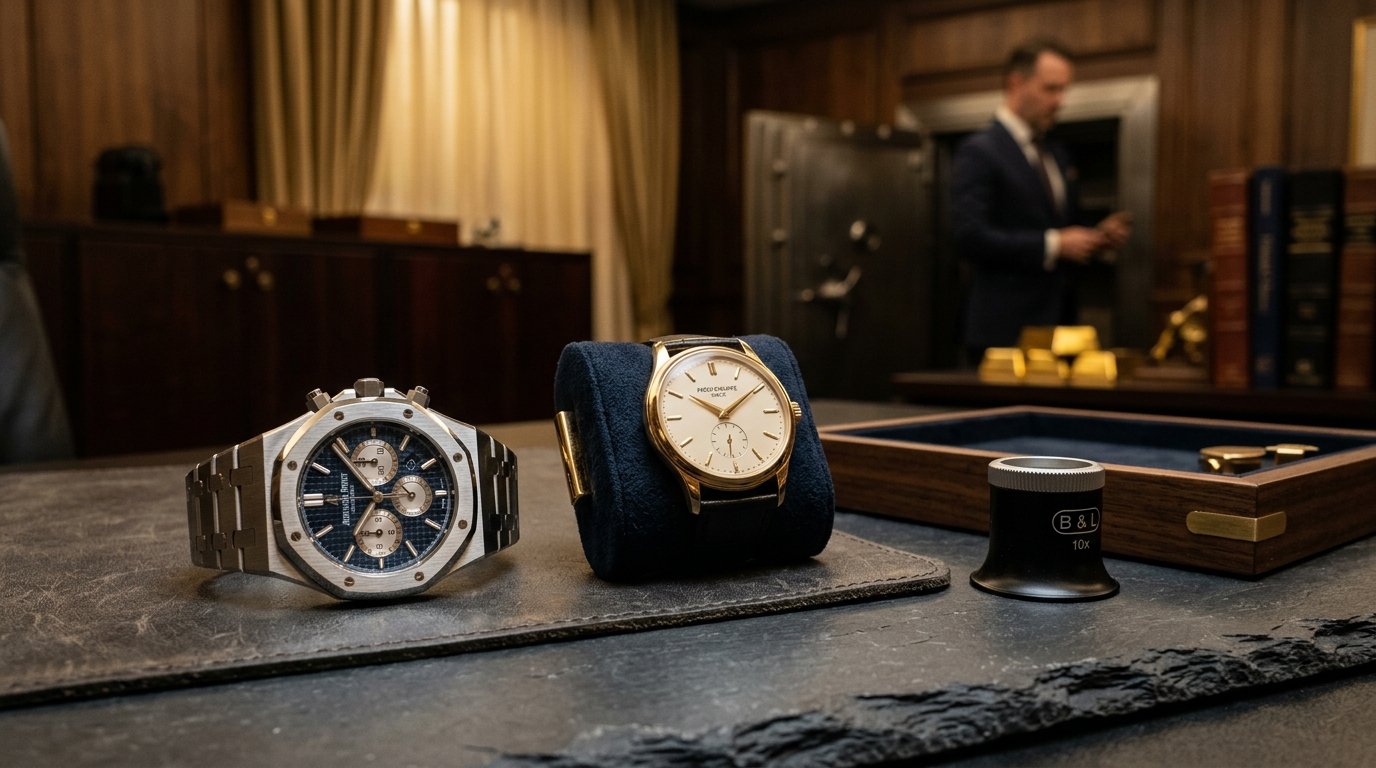
The Complete Guide to Borrowing Against Luxury Watches
Understand how collateral lending against luxury timepieces works without selling. Learn about LTV advance formulas, non-recourse legal protections, insured custody protocols, and avoiding predatory pawn terms.
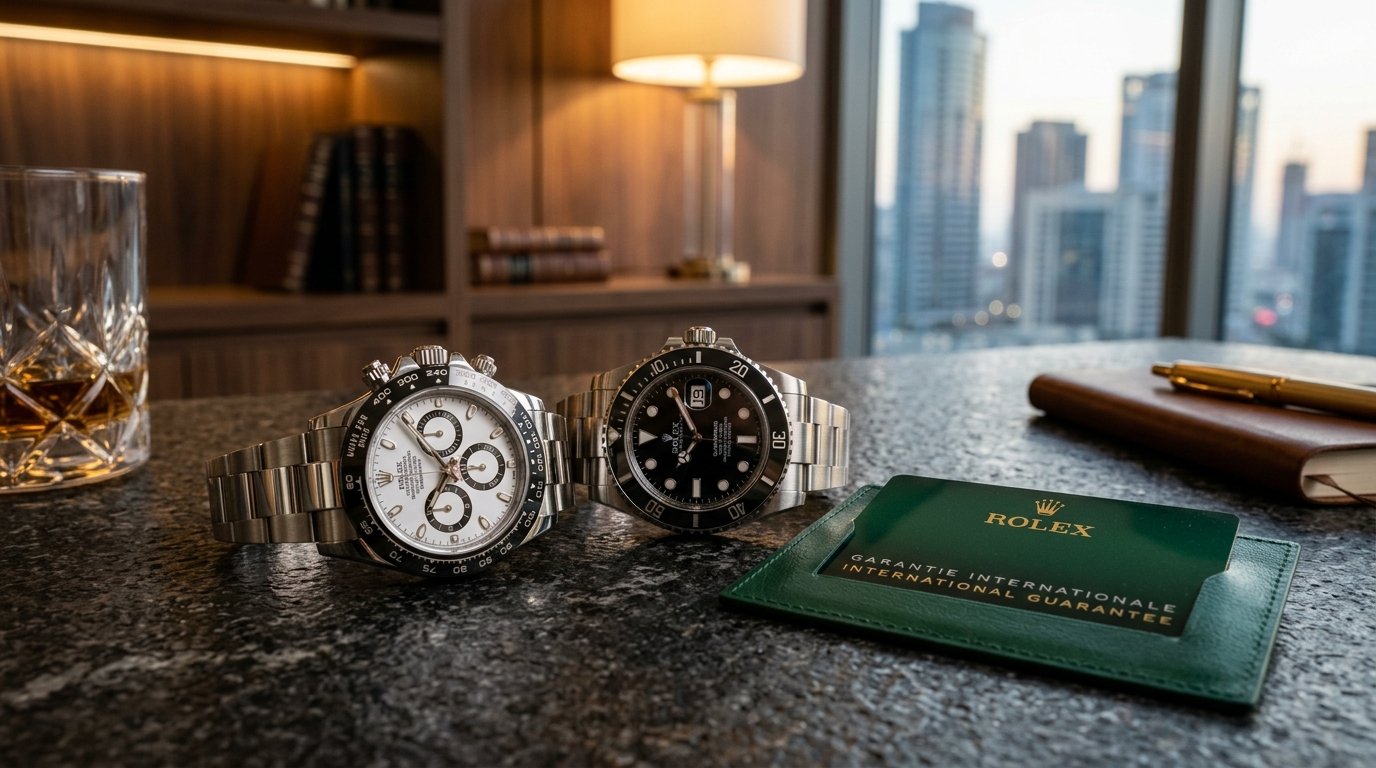
Rolex Loan-to-Value Benchmarks: Reference Valuations & LTV Guide
Explore current loan-to-value benchmarks and indicative capital advance amounts across key Rolex sports and dress references. Understand how reference liquidity tiers impact lending terms.
Collateral Loan vs. Selling Outright: Capital Without Asset Surrender
Evaluate the financial trade-offs between selling your luxury watch and securing a non-recourse collateral loan. Compare dealer discounts, auction fees, tax liabilities, and future replacement costs.